






Following the arrival of aliens known as Occupants, the world has succumbed to a mysterious disease that they brought with them. Protagonist Watcher’s story starts a thousand years after the first contact, in an underground facility known as the Orchard. It is populated by clones of the immortal Iris, known as the ALLMOTHER among Watcher and her clone sisters.
Each sister has a unique role, with Watcher having the privilege of reliving Iris’ memories through the Communion process with the assistance of Secretary, a floating AI companion. Through the Communion, Watcher can preserve Iris’ legacy. What begins as dutiful observation quickly becomes something far more disquieting, as she uncovers secrets that challenge everything the Sisters have been raised to believe.
Your task: watch her
1000xRESIST’s opening hours are intentionally disorienting. As Watcher, you understand almost nothing about your world except your function: explore the ALLMOTHER’s memories. The Orchard feels eerily isolating, with vast areas that are sparsely populated. It’s a striking setup that inevitably entices the player to want to learn more about this peculiar universe.
As you step through Iris’ memories, the mystery deepens. You relieve past events, spanning decades, observing pivotal moments of her life, from her high school years to the arrival of the Occupants to the establishment of the Orchard.



The early memories paint a familiar, contemporary setting. However, it feels alien to Iris and her Communion partners. Ordinary experiences such as eating solid food or witnessing rainfall are alien concepts to these characters. This indicates how things have evolved in Watcher’s current timeline and further contributes to the worldbuilding.
1000xRESIST’s main draw is its plot. The game uses nonlinear storytelling to great effect. As you jump between Iris’ scattered memories, you initially get pieces of the events. A lot of things remain unanswered, but there is a reason for everything being the way it is in the current and past timeline, and it all comes together as you progress through its 10 chapters. This narrative design is intriguing and well executed, blending well with the game’s universe.
Navigating through the ALLMOTHER’s memories
While your main task as Watcher is to navigate through Iris’ memories, it is not a passive process. You can manipulate time, leap across distances, and interact with memory fragments to unlock new areas. There is also an element of puzzle-solving. Some require switching between moments in time to remove barriers or memorising elements of NPCs’ conversations. These don’t offer much of a challenge, resulting in a game that feels guided.
In later chapters, your actions have more weight as they determine the ending that you experience. This adds some replay value to the experience, as well as a layer of player agency in a game that is otherwise mostly linear.
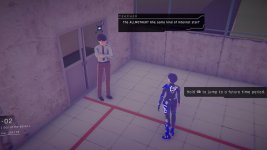
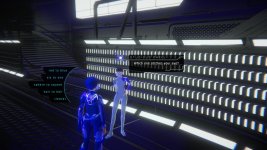
The experience isn’t far from that of a walking simulator, but it is more involved than what generally defines the genre. While combat is nonexistent, the game does more than simply ask you to walk from scene to scene. The ability to leap across platforms and shift timelines adds momentum to exploration, reducing the monotony that walking sims can succumb to.
Still, there are moments when 1000xRESIST slows too much. Several narrative and gameplay sequences feel dragged, and the vastness, yet limited interaction in the Orchard feels especially lonely, even if it is by design. Add to that some backtracking between familiar locations, and the pacing occasionally stumbles.
A triumph in storytelling
1000xRESIST’s issues never fully overshadow its strengths: the non-linear storytelling with shifting perspectives in a futuristic, yet somewhat familiar setting. Its innovative narrative mechanic and persistent mystery kept me coming to the game, even when its pacing faltered.
If you appreciate games that prioritise narrative ambition and world-driven mystery over traditional gameplay, 1000xRESIST is well worth your time.
Recommended Comments